

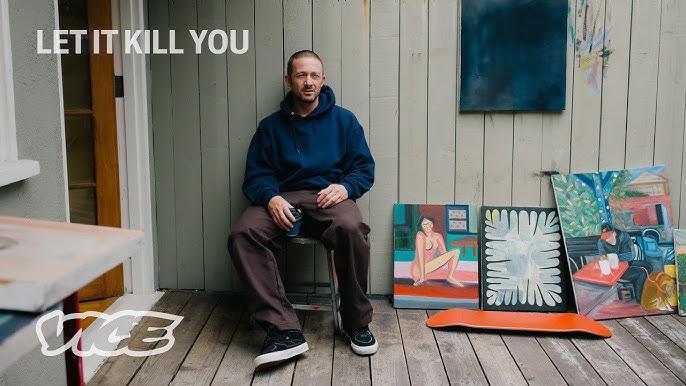
How did Let It Kill You come to life, and what’s the story behind the title?
Ben Mc’Queen (BM): During COVID, I was out of work and couldn’t tattoo for almost nine months. I was spinning out pretty bad and needed somewhere to direct my creative energy. I was also skating more than I had in years with all the free time. That’s when I had the idea to create a book about the intersection of skateboarding and tattooing—two major parts of my life.
After the book sold out, I was left with a creative void. While making the book, I kept thinking about how cool it would be to do a video series based on it. So, I made some calls and used the money from the book sales to get started on the show.
What was your original vision for the show, and how has it evolved?
BM: Initially, I envisioned something centered on skateboarding and tattooing. But I decided to broaden the scope to explore skateboarders and their creative contributions—whether in skating or other artistic ventures. I’m fascinated by the drive skaters have to create things.
How did you both get into skateboarding, and how does it shape your creative process?
BM: I started in sixth grade. My town had three elementary schools, and they all merged in middle school. That’s when I met some skaters for the first time. I’d never even seen skateboarding on TV before—I was instantly hooked. A friend and I shared a board and practiced in his basement after school. That was it for me.
Nick Andre (NA): Same grade for me—sixth. My first friend at my new school was a skater. I had just spent the summer in San Diego with cousins who introduced me to skating. When I came back, my friend and I met other skaters at middle school. I grew up in Bakersfield, CA, and we didn’t have much to do, but there were tons of skate spots, a cool music scene, and endless housing developments under construction. We’d build backyard half pipes and driveway quarter pipes with stolen wood—classic.

Epicly Later’d’s Patrick O’Dell
What role does filmmaking play in telling skateboarding stories differently?
BM: I don’t approach it differently just because it’s about skating. That kind of mindset can block the emotion. I treat it like any documentary project—look for the story and follow it.
NA: From the music side, it’s special to contribute to a culture that shaped me. Most of my musical influences came from skate videos I watched growing up. It’s full-circle to now be contributing to that tradition.
What’s your collaboration process like as creative partners?
BM: We’ve built a solid workflow. Once we lock the picture in post-production, I pass it off to Nick. I stay out of his way—he knows exactly what he’s doing. I love getting his perspective on how to shape the mood with music after he watches the cut.
NA: Yeah, once we have the story laid out, I go through my music library, pull out a few partial tracks that might work, and build from there. Every episode is different, so I tailor each score to match the subject’s story and vibe.
What’s a typical production day like for Let It Kill You?
BM: Ideally, we get a lot done in a day—though it doesn’t always pan out that way. I prefer spending the afternoon with the subject doing activities, capturing them in motion. If that’s not possible, I try to knock out as many interviews as I can. I like when people interact with old memorabilia—it jogs memories and makes interviews more natural.
NA: I’m constantly working on music, so when I get the edit, I dig into my archives for elements I like. Then I start building or rebuilding tracks to suit the vibe. I work section by section until it all clicks. Every episode has had its own unique rhythm.

Andrew Reynolds
What’s been the biggest challenge in making the show?
BM: Definitely the logistics. Coordinating interviews and shoots with a small team can be rough. People’s schedules don’t always align. Some days it’s just a waiting game to get the green light to swing by someone’s place. But we’ve learned to adapt and get better with each shoot.
What has working with Vice made possible that you couldn’t have done elsewhere?
BM: Anyone can make a show, but Vice guarantees reach. With 19 million YouTube subscribers, our stories get in front of a huge audience fast. It doesn’t change how I make the show, but it’s great knowing these stories will be seen.
NA: Agreed. We put a lot into every episode, and Vice helps get it out there on a massive platform. That’s invaluable.

Lance Mountain.
Any behind-the-scenes moments that stand out?
BM: So many. We shoot way more than what makes the cut. Sometimes scenes we thought were gold don’t work at all. One standout was the day with Mark Appleyard for Arto’s episode. We went through his old photo collection from the Flip days—it was epic. He hadn’t looked through them in years. It was special to experience that moment with him.
Who are some dream guests you’d love to feature?
BM: Definitely Mark Gonzales, Julien Stranger, Barry McGee. I’m really drawn to people who are more private—it makes the storytelling more compelling.

How do you balance the grit and beauty of skateboarding in the show?
BM: By not focusing solely on the skating. I dig into the personal, emotional side of the subject. Vulnerability is everything. If someone trusts you enough to go there, you can capture something powerful.
NA: I love juxtaposing heavy visuals—like Arto slamming his head on concrete in slow-mo—with rich audio, maybe orchestral strings or moody synths. It transforms the emotion of the scene and gives it unexpected depth.
What does Let It Kill You mean to you personally?
BM: It means everything. This project has been my baby for four years. It’s evolved from a book into a show, and who knows what it will become next. That evolution feels natural, and I’m just along for the ride.

Arto Saari
Where do you see the show heading in the next year?
BM: I try not to get ahead of myself—I just want to keep making these episodes. The more stories I can help tell, the better. I hope to keep working with Nick, Trevar Cushing, Jason Georgiades, and Travis Wood. We’re a small crew, but that’s our strength.
NA: We’ve built a really solid team. Everyone is great at what they do, and it feels good to be part of something meaningful. I hope we keep telling stories together for a long time.