

Snowboarding has always belonged to the outsiders — the kids who didn’t fit neatly into lanes, the ones who saw mountains as playgrounds and rules as optional. Every era produces its innovators, but only a few brands ever manage to capture that spirit and amplify it. Forum Snowboards wasn’t just one of those brands — it was the brand that taught snowboarding how to think about itself.
For over 35 years, Forum has existed as a belief system. It reshaped freestyle riding, redefined team culture, elevated video filmmaking, and proved that style could matter more than medals. Its rise was meteoric, its collapse painful, and its return deeply symbolic. This is the full story — not as nostalgia, but as cultural record.
BORN FROM NECESSITY, NOT MARKETING
Forum Snowboards was founded in 1996 by Peter Line, at a time when snowboarding was growing rapidly but losing texture. The industry was becoming louder, shinier, more predictable. What it lacked was soul.
Line didn’t want to build a traditional snowboard company. He wanted to create a platform where riders could experiment freely — with tricks, graphics, videos, and identity. Forum was rider-owned, rider-led, and unapologetically expressive. It was built around the idea that snowboarding wasn’t just about performance — it was about how things were done and why they mattered.
That ethos would soon crystallize into the most influential team the sport has ever seen.

THE FORUM 8 — A SUPERTROUPE THAT CHANGED EVERYTHING
The Forum 8 weren’t assembled to dominate contests or check marketing boxes. They were chosen because each rider represented a different way of thinking about snowboarding. Together, they formed a creative ecosystem — style clashing with technique, intuition balancing discipline.
Peter Line — The Architect
Peter Line was the gravitational center. As a rider, he was technical, playful, and endlessly inventive. As a thinker, he understood that snowboarding’s future wasn’t just about tricks, but about presentation and perspective. He brought intention to everything — from board shapes to team chemistry — and trusted riders to define progression on their own terms. Forum exists because Line believed creativity thrives when it isn’t micromanaged.
JP Walker — The Style God
JP Walker didn’t just influence snowboarding — he defined how it should look. While others chased symmetry and perfection, Walker rode on instinct, timing, and feel, making the hardest things look effortless and unforced. His style was loose but controlled, fluid without ever feeling careless — a balance few could replicate.
Long before freestyle was boxed into categories, JP erased the lines between park, street, and backcountry. He treated features as suggestions, not instructions, prioritizing flow and individuality over technical excess. If snowboarding has a style standard, JP Walker set it — and no one has surpassed it.
Jeremy Jones — The Jib Scientist
This is freestyle Jeremy Jones — the technician. His riding was precise, methodical, and deeply intentional. Every movement had purpose. Jones approached jibbing like a problem-solver, dissecting features and rebuilding them through clean execution and impeccable timing.
He brought discipline to creativity, proving that style could be engineered without becoming robotic. In a team defined by personality, Jones represented control — the reminder that mastery often speaks quietly.
Devun Walsh — The Soul Translator
Devun Walsh brought emotion to snowboarding. His riding felt instinctive, almost conversational — less about landing tricks and more about expressing movement. He translated skateboarding’s rhythm directly onto snow, prioritizing feel over flash.
Walsh made snowboarding human. His influence lives in the riders who value flow, timing, and authenticity over spectacle.
Bjorn Leines — Precision with Teeth
Bjorn Leines rode with sharp intent. Clean lines, locked-in tricks, zero hesitation. His style balanced aggression with control, pushing technical street riding forward without sacrificing aesthetics.
Leines showed that progression didn’t need chaos — it needed commitment.
Wille Yli-Luoma — Quiet Mastery
Wille Yli-Luoma never demanded attention. He earned it. His riding was smooth, calculated, and relentlessly consistent — the kind that rewards close study. In a team full of big personalities, Wille represented depth and patience.
He embodied the idea that true progression doesn’t announce itself — it simply exists.
Joni Malmi — European Fire
Joni Malmi injected volatility into the mix. His riding was explosive, inventive, and unpredictable, carrying a distinctly European energy into a North American-dominated scene. He expanded Forum’s influence globally and reminded the team that creativity thrives at the edges.
Chris Dufficy — The Glue
Every great group needs balance. Chris Dufficy provided it. His riding was smooth, stylish, and dependable — never flashy, always effective. He made difficult things look natural, which is the hardest skill of all.
Dufficy represented Forum’s deeper ethos: progression without ego.
VIDEO CULTURE AND TOTAL DOMINATION
Forum didn’t just release snowboard videos — it reshaped how snowboarding was documented. Films like The Resistance weren’t advertisements; they were cultural statements. Riders became characters. Spots became legend. Tricks became reference points.
Boards like the Youngblood and Destroyer became icons — not just for how they rode, but for what they represented. Owning one felt like aligning yourself with an idea.
Forum didn’t chase trends. It set them.
THE COLLAPSE — WHEN CULTURE MEETS ACCOUNTING
As snowboarding matured, the economics hardened. Independent brands struggled to survive in an increasingly corporate ecosystem. In 2004, Forum was acquired by Burton Snowboards. For a while, the brand survived under that umbrella, but its edge dulled.
By the early 2010s, Forum quietly disappeared. Production stopped. Then silence.
For a generation of riders, it felt like losing something personal.
THE YOUNGBLOODS — THE ECHO CONTINUES
Forum’s influence never stopped. Riders like Stevie Bell, Nate Boznung, John Jackson, Jake Welch, and others carried its DNA forward — prioritizing creativity, style, and individuality in a sport increasingly obsessed with metrics.
Forum had taught snowboarding how to think. That lesson stuck.
THE RETURN — DOING IT RIGHT THIS TIME
Forum’s resurrection wasn’t a nostalgia play. It was a reclamation. With Peter Line back at the center, the brand returned smaller, sharper, and intentional. No rush. No dilution. Just a continuation of the original philosophy.
This version of Forum isn’t about domination. It’s about meaning.
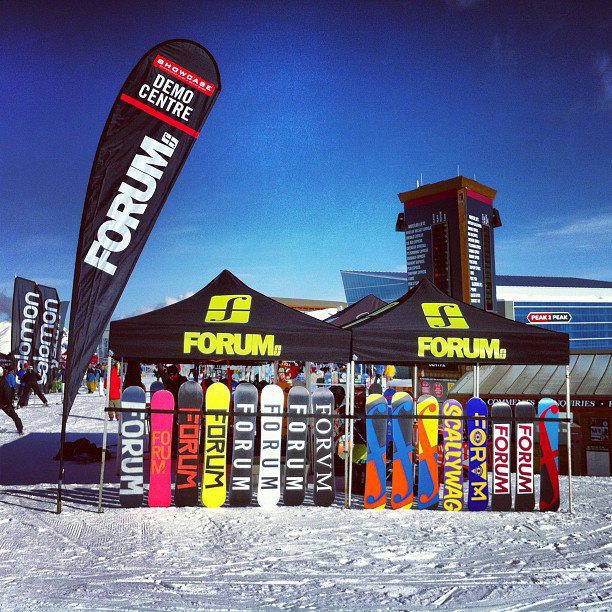
WHY FORUM STILL MATTERS
Forum Snowboards didn’t just make snowboards. It protected snowboarding’s soul.
It taught riders that style is substance. That creativity matters. That culture can’t be manufactured. Thirty-five years in, Forum’s legacy isn’t measured in trophies or sales figures — it’s measured in how riders approach a rail, a line, a life.
Forum was never just a brand.
It was a belief system.
Forum forever.