
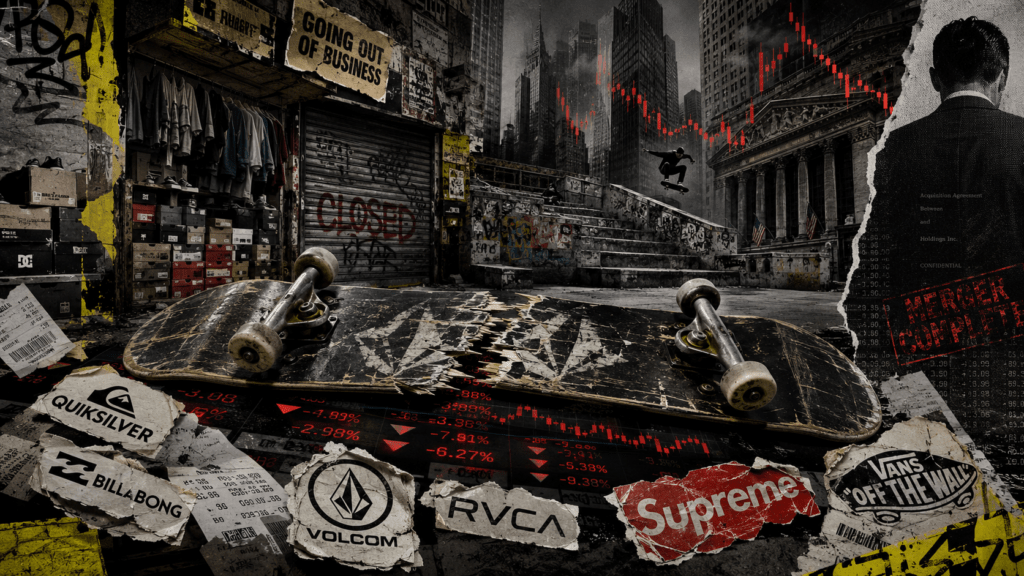
Quiksilver, Billabong, Volcom, RVCA, Supreme, Vans. You still see those names around, but the spark that made them special? It got ground down and sold off by people who only care about the bottom line. The culture’s gone—just chopped up and auctioned off, until there’s nothing left but a logo slapped on whatever’s trendy this year.
Skateboarding’s always gotten by on grit. Cops chasing you out, cities banning boards, parents calling you a burnout, the Olympics, the energy drink blow-ins—they all showed up and skating kept rolling. Even those endless “extreme sports” gimmicks cooked up by guys who’d wipe out trying an ollie haven’t sunk it. But Wall Street? That’s a whole new kind of enemy.
This isn’t about kids quitting or skateboarding dying. People are still bombing hills and swiping candle wax. Filming on cracked phones, hanging at skate shops until they get the boot. The heart’s still there. What changed is the companies—the ones that used to channel all that madness into wild graphics, trips, busted jeans, and risky ideas—turned themselves into spreadsheets.
Then February 2025 hit. Liberated Brands—running Quiksilver, Billabong, Volcom, Roxy, RVCA, DC Shoes, Element, the works—filed for bankruptcy. They racked up $226 million in debt. Secured, unsecured, unpaid royalties—the math piles up on brands that used to promise rebellion and freedom. That’s the whole story: skaters built the vibe, finance sent the bill.
It’s not like the brands just disappeared. Nah, what happened is emptier. First it’s buyouts, layoffs, cutting anything not nailed down—decisions that look good to investors but are clueless if you’ve ever kicked a curb. Authentic Brands Group scooped up Boardriders (that’s Quiksilver, Billabong, RVCA, DC, and more) in 2023, tossing them onto a pile with Volcom, Airwalk, Vision Streetwear. They put out a press release bragging about billions in sales, thousands of stores, e-commerce in 35 countries.
Looks impressive. Really, it’s a bad sign.
See, once a skate brand is “just an asset,” everything changes. You’re not hooking up the weird local kid anymore. You’re not helping the filmer who’s couch-surfing across the country or making graphics that get banned from high schools. You’re just there to hit numbers for some quarterly report. Global reach. Reliable profit. Predictable growth.
That’s not skateboarding.
Skateboarding runs on different rules. Shops matter because somebody remembers you. Videos matter because someone ate pavement for half a year just to get a trick. Graphics matter because they piss off the right people. Shoes matter if actual skaters thrash them. The money—if there’s any—comes later.
Wall Street hates that. If there’s no margin, there’s no point.
Really, none of this is new. The Center for Economic and Policy Research pointed to World Industries and Steve Rocco as one of the first warning signs. Back in the ’90s, Rocco and crew basically invented modern skate brand attitude: rude, irreverent, anti-everything. Private equity showed up in 1998 and bought World for $29 million, then flipped it soon after. Each sale squeezed out what made it tick, until it was just a name. The trendsetter turned into a ghost.
That’s the play: buy the culture, gut it, flip the shell.
Same story with Dwindle Distribution—almost, Blind, Enjoi, Madness. Not just a logo. Real teams, in-jokes, wild videos, actual connections. But the buyouts rolled in, then the layoffs. The people who cared got canned, riders left, Enjoi faded, and the website’s a ghost town.
To the suits, that’s “streamlining.” For skaters, they just ripped out the guts and wondered why it died.
Boardriders did the same, just on a bigger scale. Quiksilver went bankrupt in 2015, got scooped up by Oaktree, ate Billabong, then picked up more brands like RVCA, Element. Authentic Brands swallowed Boardriders. Liberated Brands picked over the scraps. Then Liberated crashed, too.
And this is the nasty part: The logos don’t need culture to sell T-shirts.
Trademarks stick around. Web stores just swap owners. Licenses shuffle to someone new. Shirts still hit store shelves. Inside Retail said Authentic Brands yanked companies from Liberated for missing royalty payments, gave them to new partners, while Liberated axed nearly 1,400 jobs and closed offices.
Most people don’t notice. The logo goes on hoodies. The Instagram keeps posting. But the actual network—the skaters, the warehouse crew, the designers, the core people—they get run over.
People say these brands are just line items now, and it’s dead-on. That’s literally how the system works today.
Supreme’s its own warning flag. They built their rep by knowing “cool” isn’t something you can manufacture or buy. Then Carlyle took a stake, and by 2020, VF Corporation signed a check for $2.1 billion. Now, Supreme’s a bullet point in somebody’s “consumer transformation” strategy. In 2024, EssilorLuxottica—yes, the sunglasses empire—grabbed Supreme for $1.5 billion cash. That brand you once had to know someone to even see? Now it’s just another line in an earnings call.
Vans has been owned even longer—VF bought them in 2004. Vans still does stuff for skaters, but now, the DNA’s jammed in a spreadsheet alongside Dickies, The North Face, Jansport—whatever else is hot this quarter. The shoes are for real. The numbers? All corporate calculations.
Folks defending this always shrug and say, “That’s business.” Yeah, it is. That’s the whole problem.
Skateboarding was never pure. Brands always hustled. Pros needed paychecks. Mags ran ads. Even the most anti-corporate hero wanted that royalty check. There was no real golden age.
But there was a difference. When business grows out of culture, it feels different than when money just crushes its way in from the top.
A skater can mess up a brand. A store can go broke. A founder can sell out. Old news. What’s changed is the size of the machine—and how cold it is. Private equity doesn’t care about your team or your shop. Unless it makes more money, it’s gone. Graphics, trips, videos? Only if they turn into licensing cash or liquidation money.
That’s how a real culture gets separated from what made it live.
And the really weird part? Skateboarding’s all about image, so the death looks alive. The shirts keep printing. The Instagram keeps chirping. The website still shouts “authentic.” But authenticity isn’t a button on a website—it’s what happens when money keeps moving back into shops, crews, videos, zines, trips. When that stops—or just flows up and out to pay back debt, fund buyouts, juice shareholder value—you know it’s been gutted.
The punchline? Wall Street wanted in because