
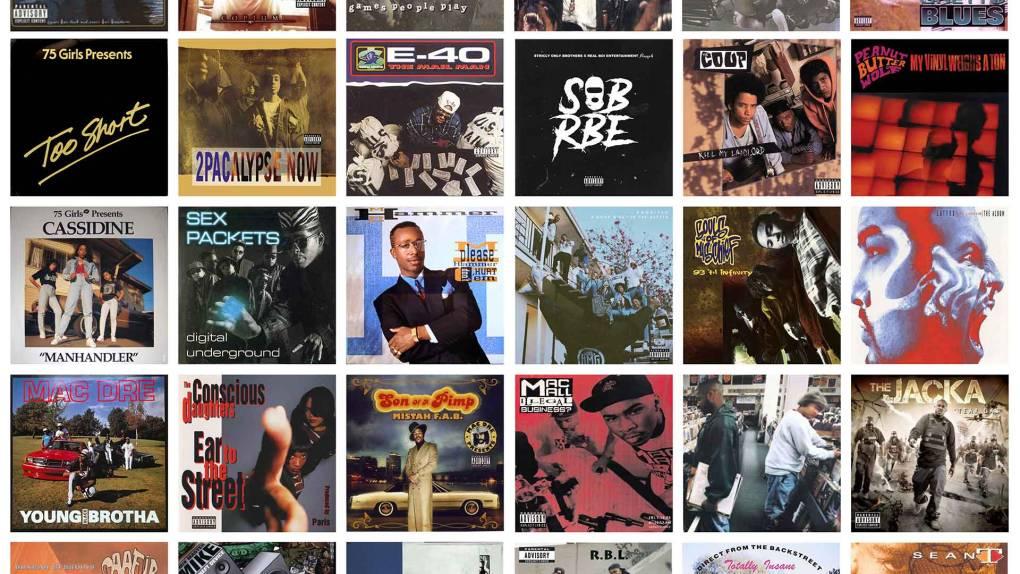
Before hip-hop had rules, the Bay Area was already breaking them.
Long before algorithms, A&Rs, and streaming metrics told artists how to move, Northern California was building something looser, louder, stranger, and radically independent. The Bay didn’t chase New York. It didn’t mirror Los Angeles. It didn’t wait its turn. It built its own economy, its own slang, its own rhythm—rooted in funk, radical politics, street survival, car culture, and a deep distrust of the mainstream.
Bay Area hip-hop isn’t a genre.
It’s a mindset.
BEFORE HIP-HOP HAD A NAME
The Bay’s musical DNA predates rap itself. Oakland and San Francisco were already steeped in funk, jazz, spoken word, and Black liberation politics. Sly Stone blurred race and genre. Tower of Power made funk militant. The Black Panthers made Oakland a global symbol of resistance. Rhythm and rebellion were already inseparable.
By the ’70s, block parties, park jams, and mobile DJ crews were thriving—parallel to what was happening in the Bronx, just without the cameras. The Bay wasn’t interested in documenting history. It was busy living it.
TOO $HORT & THE BAY’S ORIGINAL BLUEPRINT
If there’s a godfather of Bay rap, it’s Too $hort—no debate.
Before majors cared about Northern California, Too $hort was pressing tapes in his apartment and selling them out of his trunk. No radio. No gatekeepers. Just explicit Oakland reality, sold hand-to-hand. He didn’t just change how rap sounded—he changed how it moved.
Too $hort proved independence wasn’t a fallback plan. It was the plan.
That philosophy would become the Bay’s most important contribution to hip-hop.
TUPAC SHAKUR: THE BAY’S MOST IMPORTANT ADOPTED SON
Before the world crowned Tupac the voice of a generation, the Bay helped shape him.
After moving to Marin City, Tupac absorbed Northern California’s blend of militant politics, artistic freedom, and street reality. His early work with Digital Underground gave him a platform—but the Bay gave him perspective. Activism, poetry, rage, compassion—all colliding in one voice.
Tupac carried the Bay’s spirit into the mainstream and refused to dilute it. Even when the spotlight grew global, his foundation stayed Northern California.
Pac wasn’t just from the Bay.
He was of it.
THE INDEPENDENT ECONOMY (BEFORE IT WAS COOL)
The Bay didn’t wait for record deals—it built its own infrastructure.
Local labels, mom-and-pop record stores, barbershops, gas stations, car shows—this was distribution. If you moved units, you mattered. Period.
That ecosystem birthed legends across every lane: E-40, Spice 1, MC Hammer, Digital Underground, RBL Posse, Hieroglyphics—all different, all unmistakably Bay.
Ownership wasn’t a buzzword.
It was survival.
DEL THE FUNKY HOMOSAPIEN & THE ART-RAP INSURRECTION
While gangster rap dominated headlines, the Bay quietly built an alternate universe.
Del the Funky Homosapien, along with the Hieroglyphics crew, proved Bay rap could be cerebral, futuristic, weird, and lyrical without losing its edge. They sold records hand-to-hand, toured relentlessly, and built community instead of chasing radio.
Del didn’t just rap outside the box—he threw the box away.
This was backpack rap before the term existed, and independence before it was monetized.
ANDRE NICKATINA: SAN FRANCISCO AFTER DARK
If Too $hort was the hustler and Del was the futurist, Andre Nickatina was the nocturnal poet.
Formerly Dre Dog, Nickatina painted surreal, street-level portraits of San Francisco life—drug dreams, paranoia, humor, violence, and vulnerability all colliding in the same verse. His music felt unfiltered, intimate, and unsettling in the best way.
Never chasing trends, Nickatina built a cult following by being relentlessly himself.
Bay legend status: earned, not marketed.
MAC DRE, HYHY & THE SOUND OF CONTROLLED CHAOS
Then came Mac Dre—and everything shifted.
Mac Dre turned regional slang, fashion, and behavior into full-blown culture. From jailhouse recordings to independent dominance, he embodied the Bay’s fearless, joyful rebellion. Out of that energy came Hyphy—fast beats, sideshows, ghost-riding, thizz faces, and uncontainable movement.
Hyphy wasn’t polished.
It wasn’t safe.
And it wasn’t meant for outsiders.
When the rest of the world caught on, the Bay was already ten steps ahead.
LIVING LEGENDS & THE LONG GAME
While others chased hits, crews like Living Legends played chess.
Owning their masters, touring globally, and building direct relationships with fans, they showed that underground wasn’t a stepping stone—it was a destination. Longevity over hype. Freedom over fame.
The Bay always understood the long game.
THE BAY TODAY (AND FOREVER)
From Larry June’s smooth hustler philosophy to Mozzy’s raw street realism, the Bay’s influence still runs deep. Slang, strategy, independence—it’s all there. The industry finally caught up to ideas the Bay lived by decades ago.
Streaming made everyone DIY.
The Bay did it with CD-Rs and car trunks.
WHY THE BAY STILL MATTERS
Bay Area hip-hop never cared about being crowned king. It cared about ownership, originality, and survival.
It made weird cool.
It made hustle art.
It made community currency.
While the rest of the world argued about what hip-hop should be, the Bay was already doing what it needed to do.
The Bay never followed.
The Bay just moved.
— Frank 151