
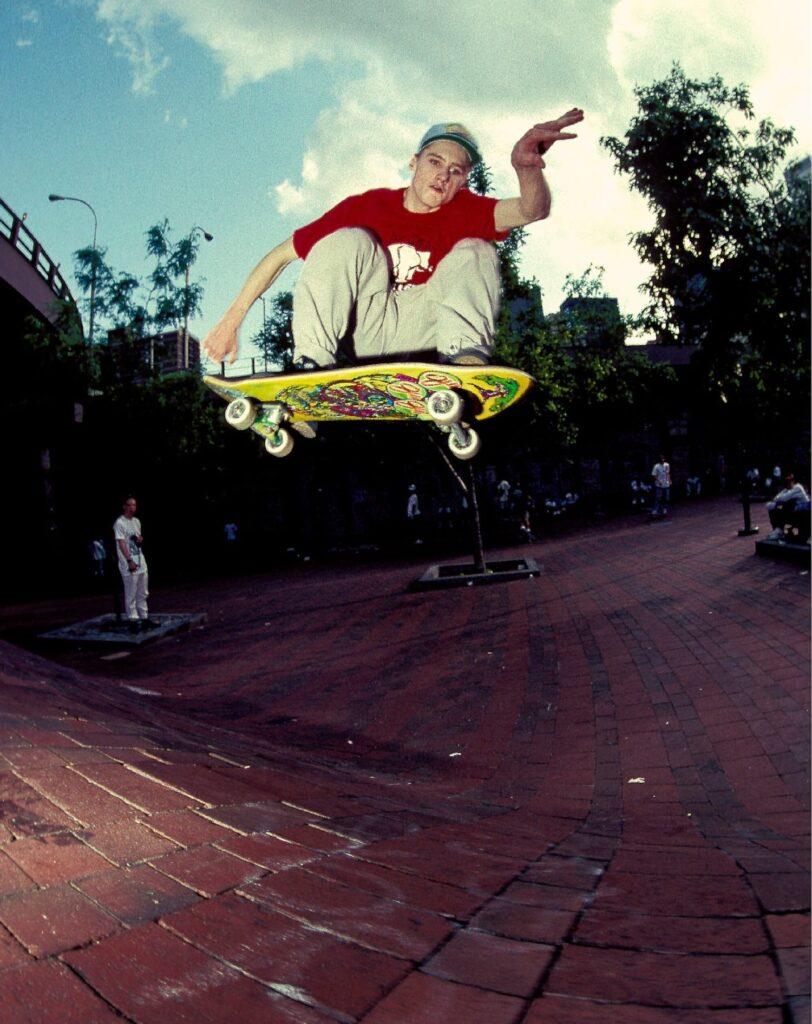
Nestled beneath the Manhattan side of the Brooklyn Bridge, the Brooklyn Banks have long stood as a testament to skateboarding’s gritty, urban spirit. From their accidental inception in the 1970s to their triumphant reopening in 2025, the Banks’ journey mirrors the resilience and passion of the skate community that has fought tirelessly to preserve them.
Origins: From Urban Design to Skateboarding Mecca
Designed by landscape architect M. Paul Friedberg and completed in 1972, the Brooklyn Banks were initially part of a broader urban development plan. The area—defined by its distinct red-brick slopes and located beneath the bridge’s off-ramps—was never intended for skateboarding. But by the mid-1980s, it had become just that.
Drawn by the unique architecture and lack of skate-friendly spaces in NYC, skateboarders began to repurpose the Banks as their own. Despite being a stone’s throw from NYPD headquarters at 1 Police Plaza, the spot quickly evolved into an underground sanctuary. Shielded by the massive bridge structure, it allowed for uninterrupted sessions and birthed a community that helped define New York City skateboarding.
Challenges and Closure
As the 2000s rolled in, so did complications. In 2004, the Upper Banks were lost to city renovations. Then in 2010, the entire area was shuttered, fenced off, and converted into a construction staging area for Brooklyn Bridge restoration. What was once a cultural stronghold became inaccessible.
But the community refused to give up. Led by skaters like Steve Rodriguez, an aggressive campaign to save the Banks began. Over 53,000 signatures were collected in support of reopening the space. The Banks weren’t just concrete and bricks—they were sacred ground.
Revival and Reopening
Their efforts finally bore fruit. In 2023, the city unveiled a partial reopening of the Banks in time for the 140th anniversary of the Brooklyn Bridge. This was part of a broader civic initiative called “The Arches,” aimed at reclaiming underused public space.
Then, on June 5, 2025, after 15 long years, the Brooklyn Banks officially reopened to the public. Restored brickwork, improved facilities, and a renewed commitment from city officials—this was more than a comeback. It was a rebirth. The resurrection was made possible through collaborations between skate activists, community leaders, and partners like The Skatepark Project and Gotham Park.
Legacy and Cultural Impact
The Brooklyn Banks have always been more than a skate spot. They’ve been a breeding ground for legends—Harold Hunter, Mike Vallely, Chad Muska, and countless others. Tricks done here have been etched into skate video history.
But their significance runs deeper. The Banks are proof that urban spaces can be repurposed by the communities who care about them. They’re a symbol of what happens when art, movement, and community meet concrete.
A New Chapter
Today, the Brooklyn Banks are open once more. Their return isn’t just a win for skateboarders—it’s a win for New York City’s cultural soul. In a city that’s constantly changing, they remind us that some things are worth fighting for.