
Flying into Italy next week, the Olympic flame suddenly remembers how much it adores oddballs. It acts like that was true from day one.
Winter games inch closer. Snow falls again. New logos pop up everywhere. Officials talk big on young talent, moving forward, art shows — while holding tight to TV rights and plastic badges stamped with access codes.
A hillside bends under hands carving a leap for no lens. Elsewhere, fingers smooth fabric meant for one morning alone — thoughts drift, how fences crossed long ago now lead to flags rising.
History often feels close during the Games. Bright lights hum above quiet tension building behind smiles. Yet smooth broadcasts hide sharp edges beneath. Moments polished for cameras once carried weight no replay shows. What shines now required parts left out earlier.
It wasn’t polite requests that got snowboarding into the Games. Freeskiing showed up only after it became impossible to overlook. Skateboarding made its way in by being everywhere you looked. Surfing earned a spot due to sheer cultural reach. Each one forced the door open through presence alone.
With seconds ticking down and medals gleaming under lights, a tough thought slips in — why does the Games stay silent on what really matters?
When victory finds a rebellion, what becomes of its roots?
The Olympic Games need skateboarding more than we need them.
Tony Hawk
Faster, Higher, Corporate
Once meant for divine beings, the Games shifted focus over time.
Later came talk of banners instead. That shifted things toward symbols waving on poles.
Then about TV rights.
Later on, maybe a chat about soda deals, followed by questions over if your laces break rule seven dash three part b.
Out of nowhere, action sports stumbled in — smelling like stale beer, equipment held together with gray tape — and quietly wondered if they belonged. Then came the quiet fight inside.
Built beyond boundaries, action sports found their start off limits. Outside the rules is where they grew. Where alarms flashed and voices barked orders, grins appeared anyway. Told to leave, kids stayed — quiet, steady, moving slow but sure. Fences marked lines others drew. These ones stepped past them.
Starting with snowboards, then skis, boards under feet on waves — none began as games. Instead, each grew from restlessness. Because fences, schedules, orders — it all felt too tight. So kids moved anyway, riding sideways against what was expected. Rules made elsewhere started cracking when motion became answer enough.
Rules? The Olympics can’t get enough. Lanes matter. Uniforms too. Who talks when — that’s sorted ahead of time, usually with a signature. Waivers help.
That moment they met changed everything. Not joy — just confusion wearing a brand name like a bandage on broken glass.
Nagano Where Terje Left
That winter of 1998 brought snowboarding to the Olympics for the first time — Nagano hosted it. A poorly shaped halfpipe stood there, awkward underfoot. Judges seemed unsure how to score what they saw. Honestly, something just felt wrong in the air.
Far from the crowd, Terje Haakonsen stayed away. Not a sighting, not a trace. The snowboarder most called king simply wasn’t there. Silence took his place.
Without a scratch on him. Never left out of anything. Simply said no, that was it.
It was never about medals for Terje. Snowboarding showed up raw, real, on its own terms. When the Olympics called, he stayed away. Not invited by riders but by boardrooms. Decisions made far from slopes, shaped by suits who saw chaos instead of freedom. A sport born loud got labeled messy by those who never strapped in. Approval came from panels, not parks.
Later, Terje said the Games ran on tight rules instead of fresh ideas. Snowboarding just wouldn’t sit still under that kind of grip.
Outlawed pot. Uniformity crept into fashion. Behavior was supposed to follow rules now. Snowboarding had other plans.
Far ahead of most, Terje spotted where things were headed — when the Games shape your discipline, they start shaping its rules too. Yet scoring was never the point of snowboarding.
This protest didn’t reject the Games. Instead, it stood for inner truth.
There’s just no respect for the history and culture of snowboarding at all. We don’t need FIS or the IOC. We can handle snowboarding ourselves.
Terje Haakonsen
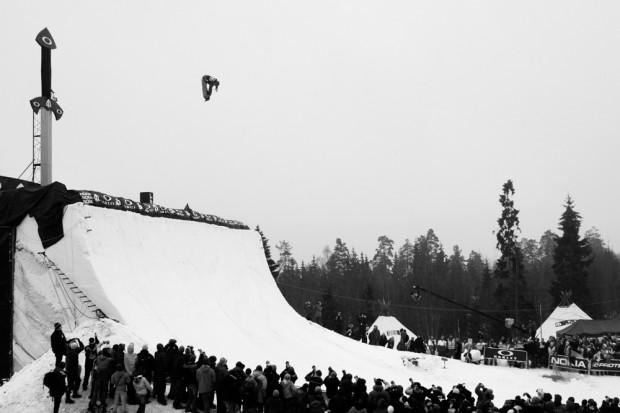
Terje in action at The Arctic Challenge. Photo: Frode Sandbech.
Freeskiing
The Moment Skiing Ignored Tradition
Freeskiing began another way, yet carried the same trouble.
Back when skiing acted like fun wasn’t allowed — like sliding backward was wrong, like joy didn’t belong on snow. Rules mattered more than laughter. Cost kept out anyone scrappy. Until a few teenagers saw boarders carving opposite ways, slapped old skis into pairs, then asked it plain: why not?
Freeskiing became skiing that finally remembered how to laugh. Park laps, city jumps, sliding steel in places snow never touches — it was winter play pretending nothing else mattered.
Back then, freestyle skiing cared less about podiums. What counted was showing up in videos. Instead of points, your worth came from how often someone hit replay on your run. Competitions took a back seat to moments that stuck.
Beyond those early days arrived slopestyle. Following close behind showed up the halfpipe. Right after that, Olympic qualification rules began appearing.
One skier nailed it when he said, “The Olympics didn’t ruin freeskiing — but they definitely taught it how to behave.”
Falling into place, moves shifted from flashy to planned. Each choice weighed its danger before going forward. Looks mattered only once both feet touched ground.
Freeskiing found its rhythm when it realized judges favored steady moves over bold new tricks. Much like snowboarding did earlier.
The Hidden Fight No One Shows
Truth is, action sports crave attention while demanding space. Yet openness rarely walks with liberty. One usually loses out when both are chased together.
Money comes with the Olympics. So does recognition, plus reach across continents. Uniforms show up too. Silence hangs around. A quiet space separates athletes, one that somehow echoes more than connects.
Few weeks before the Games began, teams moved in groups. Rolling on skates meant constant noise. Snow slopes brought more mess than wheels ever did. Rooms split between strangers, vehicles held together by wire, shoes patched with tape. Fights flared fast — gone just as quick — while bonds stuck long past the finish.
Friendships sparked when racing beside someone familiar, not a faceless figure in identical gear.
Right now? Part of a team that feels like nothing. The person beside you wants the same win. All moves are planned. Every word rehearsed for cameras. Each one heads off alone, lights out early — morning brings qualifying runs, plus the risk of being caught off guard.
As one skater put it, “We used to share spots. Now we share heats.”
Hanging out feels pointless when time could be used elsewhere. Efficiency takes priority over casual moments.
Still alive, that culture. Just tucked into calendars now. Not gone — neatly lined up between meetings and reminders instead.
Skateboarding Shifts from Sidewalk Strolls to Scheduled Sessions
Out here, skateboarding never asked for approval. Years went by with cops chasing kids off curbs, yet it stuck around anyway. Shut out, shut down — still it kept moving. Not fitting in turned out to be its fuel.
Folks started street skating by grinding against the grain. It grew when wheels hit surfaces never built for them. Danger walked alongside every trick, both on the body and out in public view.
Daylight hours brought a polished version of the event. Obstacles came vetted by officials. Outfits followed strict guidelines. Clapping happened on cue, nothing wild.
Now and then, a few skaters welcomed it. Others simply looked away. Many felt a quiet sadness over things that slipped away.
Skating changes once it turns into training, not just casual doing. That shift happens quietly, without announcement. The act feels different when effort replaces habit. A subtle difference grows where fun used to be enough. Purpose slips in, uninvited. Movement carries weight now, heavier than before. What was play becomes work, slowly. The body notices what the mind avoids. Every session asks more than the last. Nothing loud signals the change — just small moments piling up. You keep going anyway.
One Olympic skater said it perfectly without meaning to: “It’s weird skating against my friends… but that’s the format.”
Friendships mean nothing to formats.
Surfing Snow and the Same Old Script
Snowboarding showed the way, step by step. Surfing tagged along, close behind. A new chance appears — attention, space to grow, a seat at the table. Structure follows soon after. Only later does it sink in: tides run on their own clock. Heat sheets mean nothing out there.
Water sloshes in artificial rhythms. Stretchy fabric clings where loose cloth used to hide movement. Uniforms now shout names, though silence was once the goal. Recognition replaces shadow.
Freeskiing saw it first, yet snowboarding had walked that path before too.
As one snowboarder joked,
“The Olympics love us as long as we don’t act like ourselves.”
The Dark Side Existed All Along
Built on old flaws, the Games sharpened greed, pride, power — turned them into routine.
It’s strange how defiance now gets cleaned up. Lately, people who just discovered it are already breaking it down on screens. Realness turns into buzzwords right before commercial breaks.
Here’s the strange twist — without street culture, the Games lose their edge. Young crowds care about moves on snowboards, tricks on skate decks. That energy? It doesn’t come from podiums. Real cool shows up when rails get hit, when jumps go big. The spotlight leans that way now.
Yet every gain in importance carries its own cost.
Terje Might Have Been Right?
Yeah.
Still, things aren’t straightforward. Complexity shows up quietly, without warning.
Flying is what sticks in their mind. Not rules. Not grown-up worries. A screen shows motion, that’s enough. Something clicks when wheels roll fast. Boards get used hard, wrecked quick. Snow or pavement, it hardly matters. What counts is trying. Moving like that looks fun.
What really matters now is not if action sports fit in the Olympics. The moment for that debate has passed.
Maybe they’ll stick around once the Games are done — provided they remember what they were really about. Still, staying true could be harder than it seems.
Still mattering after the cameras leave, even if they stand on the podium. Winning might show on a shelf but not always in silence.
Freeskiers wonder if they still shape ramps simply to discover the outcome.
Do skaters keep showing up where they’re not allowed.
Do surfers keep riding waves when no one’s filming? Maybe they do. Could be about more than likes. Some moments stay private. Others might never show up online. The ocean doesn’t care who watches. Neither does the ride itself.
Out here, stillness speaks louder than cheers ever could. Moments rise when nobody’s watching. Quiet beats echo where spotlights fade. What matters most slips past parades unseen.
Suddenly, they appeared — no one had been counting. Moments passed without records or ledgers nearby.
Here’s what actually matters most.
Off the stand it stayed. Never made its way up.
There stood the scene — right out there, where cars sit waiting. Not inside. Out back. Empty spots stretched wide under gray light.