
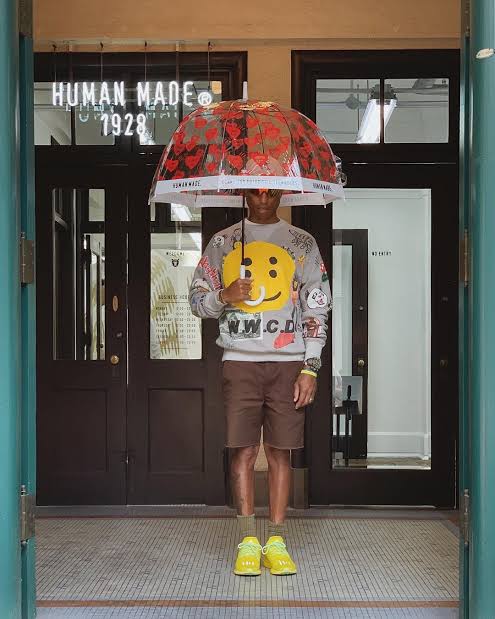
If you go back to American pop culture in the late ’90s, the uniform was easy to spot.
Baggy jeans. Oversized jerseys. Timbs. Huge leather jackets. The bigger, the better.
Denim and streetwear brands like FUBU, Karl Kani, Rocawear, Girbaud and Phat Farm fit naturally into that world. They represented a particular moment in American hip-hop culture — one built around scale, status and making a statement.
Then, something changed in the early 2000s.
A new wave of younger creatives began introducing a different, more evolved look into the cultural lexicon. And leading that movement was none other than super-producer extraordinaire Pharrell Williams.
Pharrell wasn’t wearing jeans that dragged across the ground. His shirts weren’t five sizes too big. Instead, he was wearing trucker hats, skate shoes and Japanese brands that most American fans couldn’t pronounce, let alone find in a local mall.
Without necessarily realizing it at the time, millions of young people were watching a cultural exchange happen in real time.
American hip-hop had been influencing Japanese streetwear for years. Now, Japan was sending that influence back.
But it came back refined. Reinterpreted. More expensive. More exclusive.
Pharrell found himself at the centre of that exchange.
Looking back while working on a previous video, I started thinking about just how important Pharrell was in bringing Japanese streetwear to the United States. At a time when the genre was still being shaped and defined, he became something of an ambassador — connecting worlds that had previously existed thousands of miles apart.
His influence wasn’t just about what he wore. It was about what he introduced people to.
Japanese streetwear suddenly felt aspirational to a generation of American kids discovering brands, designers and aesthetics that existed outside the traditional boundaries of American fashion.
And Pharrell wasn’t simply following the trend.
He was helping create it.
This is the story of how Pharrell Williams became one of the most important bridges between Japanese streetwear and American pop culture — and why his influence can still be seen everywhere today.